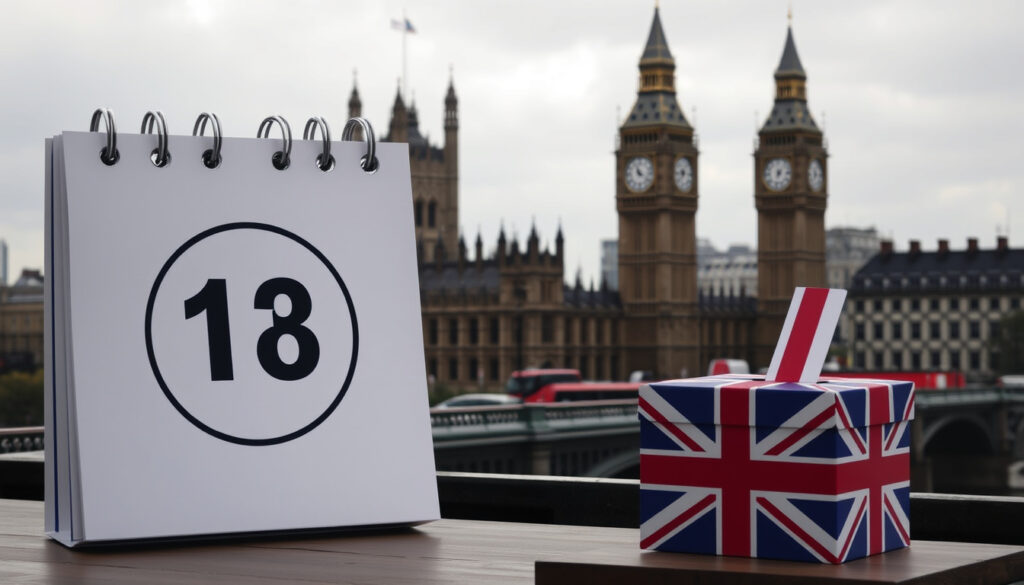
When Is the Next UK General Election? Date & Timeline Explained
Few things get people checking calendars like a national election. The last UK general election took place on 4 July 2024, and the next must be held no later than 15 August 2029.
Last general election: 4 July 2024 ·
Next election deadline: No later than 15 August 2029 ·
Maximum parliamentary term: 5 years ·
Number of constituencies: 650
Quick snapshot
- Last election: 4 July 2024 (Wikipedia: 2024 election)
- Next election deadline: 15 August 2029 (Wikipedia: Next election)
- Exact date of next election (Wikipedia: Dissolution Act)
- Whether an early election will be called (Wikipedia: Dissolution Act)
- Potential changes to electoral law (Wikipedia: Dissolution Act)
- Last election: 4 July 2024 (Wikipedia: 2024 election)
- Next election deadline: 15 August 2029 (Wikipedia: Next election)
- PM can call early election anytime (Wikipedia: Dissolution Act)
- General election to be held by 15 August 2029 (Wikipedia: Next election)
- Prime Minister may call early election (Wikipedia: Dissolution Act)
- New Parliament formed after election (Wikipedia: Next election)
These five key facts capture the essentials about the next UK general election, from the last election date to the constitutional rules governing its timing.
Here is a summary of the verified details every voter should know:
| Fact | Details |
|---|---|
| Last General Election | 4 July 2024 (Wikipedia: 2024 election) |
| Next Election Deadline | No later than 15 August 2029 (Wikipedia: Next election) |
| Current Prime Minister | Keir Starmer (Labour) (Institute for Government) |
| Number of Seats | 650 |
| Governing Party | Labour Party |
When is the next general election in the UK?
What is the deadline for the next general election?
- The next general election must be held no later than 15 August 2029, five years after the new Parliament first met on 9 July 2024.
That means the 2029 election is the latest possible date under the current rules. If no early election is called, Parliament will automatically dissolve five years after its first meeting, triggering a general election within 25 working days.
The next election could come as early as 2025 if the Prime Minister decides to call one, but the default is mid-2029. Voters should stay alert for announcements.
The implication: the five-year clock started ticking on 9 July 2024, giving the government until August 2029 at the latest to go to the polls.
Could there be an early general election?
- Yes. Under the Dissolution and Calling of Parliament Act 2022, the Prime Minister can request an early dissolution of Parliament at any time.
This law, which repealed the Fixed-term Parliaments Act 2011, restored the traditional power of the monarch to dissolve Parliament on the advice of the Prime Minister. An early election could be called because of a major crisis, a no-confidence vote, or strategic political calculation.
How often is a general election held in the UK?
What is the maximum term of a UK Parliament?
- Parliaments last a maximum of five years from their first meeting.
This five-year limit was originally set by the Fixed-term Parliaments Act 2011, which was itself repealed in 2022. However, the convention of a maximum five‑year term remains in place under common law and the terms of the Meeting of Parliament Act 1694, as confirmed by the official timetable of the 2024 election (Electoral Commission timetable).
Can parliaments be dissolved early?
- Yes. Prior to the 2022 Act, parliaments could also be dissolved early by the monarch on the Prime Minister’s request, a practice that dates back centuries.
So while the five‑year rule sets the outer limit, the actual timing of the next election depends on political decisions. Early elections have occurred multiple times in recent decades, including in 2017 and 2019.
The five‑year maximum prevents indefinite parliaments, but the early‑election option gives the sitting Prime Minister a powerful tactical tool. For voters, the uncertainty means they need to stay engaged with political developments.
The catch: the same law that restored the PM’s power to call an early election also removed the fixed‑term protections, making the next election date inherently unpredictable.
What happened in the 2024 UK general election?
Who won the 2024 UK general election?
- The Labour Party won a commanding majority in the 4 July 2024 election.
Labour secured enough seats to form a government without needing a coalition, ending 14 years of Conservative rule. Keir Starmer became Prime Minister on 5 July 2024, succeeding Rishi Sunak, who had called the election on 22 May 2024.
What is the significance of the Labour Party victory?
- It was the first time Labour won a general election since 2005.
- The election saw a record 4,515 candidates nominated.
The 2024 vote also marked the first July election since 1945, a notable break from the spring and autumn elections of the past two decades. The new Parliament first met on 9 July 2024, and the State Opening with the King’s Speech took place on 17 July 2024.
Timeline
- 4 July 2024 — 2024 United Kingdom general election held; Labour Party wins majority.
- 5 July 2024 — Keir Starmer becomes Prime Minister.
- By 15 August 2029 — Next general election must be held (unless called earlier).
- Potential early election — The Prime Minister may request an early dissolution at any time.
What’s Clear and What’s Unclear
Confirmed facts
- Next election must be held by 15 August 2029.
- 2024 election result is final; Labour holds a majority.
What’s unclear
- Exact date of the next election.
- Whether an early election will be called.
- Potential changes to electoral law (e.g., voter ID, constituency boundaries).
The pattern: confirmed facts rest on statute and official records, while the uncertainties reflect the discretionary powers restored by the 2022 Act.
Perspectives from Experts
The next general election must be held no later than 15 August 2029, five years after Parliament first met following the 2024 election.
The official timetable for the 2024 general election was set by the Electoral Commission, with key dates including the dissolution of Parliament on 30 May and polling day on 4 July.
UK Parliament (via Wikipedia)
For UK voters, the key takeaway is clear: the next general election will happen by August 2029, but it could come much sooner if the Prime Minister decides to call it. Staying informed about political developments is the best way to ensure your voice is heard when the polls open.
For a detailed breakdown of the rules and key dates, see the next UK general election timeline.
Frequently Asked Questions
What is the maximum term for a UK Parliament?
A Parliament can last a maximum of five years from its first meeting, as established by convention and the terms of the Dissolution and Calling of Parliament Act 2022.
Can a general election be held before the five-year term ends?
Yes. The Prime Minister can request an early dissolution of Parliament at any time, triggering an early general election.
How is the date of a general election decided?
The Prime Minister advises the monarch to dissolve Parliament, and the election date is then set by the government. Under the Dissolution and Calling of Parliament Act 2022, no supermajority in Parliament is required.
How many votes does a party need to win a majority?
A party needs to win at least 326 of the 650 seats in the House of Commons to secure an overall majority.
What happens if no party wins a majority?
This results in a hung Parliament. The largest party may try to form a minority government or a coalition with other parties. If no government can be formed, a new general election might be called.
When will the next general election be after 2024?
The next election must be held no later than 15 August 2029. An early election could be called before that date.
How does the UK general election system work?
The UK uses the first-past-the-post system, where each of the 650 constituencies elects one MP. The party with the most MPs usually forms the government.
What is the role of the Prime Minister in elections?
The Prime Minister decides when to request a dissolution of Parliament (subject to the five‑year limit) and is the leader of the party that wins the most seats.
More related posts
 Lacey Chabert: Biography, Family, Career, and Net Worth
 Manchester United Stadium Tour – Prices Inclusions Booking Guide
 Dean Winchester: Age, Death & Full Character Guide
 The Godfather Part II: Why It’s Better Than the Original
 Best Small Electric Car 2026: Top Picks and Buying Guide
 Jessica Osbourne: The Quiet Daughter Who Missed Ozzy’s Funeral
 VO2 Max by Age: Charts, Ratings & Calculators for Men & Women
