VO2 Max by Age: Charts, Ratings & Calculators for Men & Women
If you’ve ever checked your fitness tracker and wondered whether that VO2 max number actually means anything, you’re not alone. This metric sits at the intersection of exercise science and everyday health, and its meaning shifts dramatically depending on your age and sex. The good news: there’s solid data on what counts as excellent, good, or needs work for pretty much every age group.
Average good VO2 max for men: 30-40 ml/kg/min · VO2 max decline after age 30: around 10 percent · Excellent VO2 max for men 18-25: >60 ml/kg/min · Good VO2 max for men 65+: 33-37 ml/kg/min · Fit VO2 max threshold for males: >35 ml/kg/min
Quick snapshot
- VO2 max peaks in the late 20s for most people and then declines roughly 10 percent per decade after age 30 (Primary MD)
- The FRIEND Registry shows the 50th percentile for men drops from 48 ml/kg/min at age 20-29 to 24 ml/kg/min by age 70-79 (Luen.app)
- Higher cardiorespiratory fitness correlates directly with lower mortality risk and longer life expectancy
- Exact VO2 max values for individuals who haven’t been formally tested, particularly those in their 80s
- How much wearables like Apple Watch and Garmin overestimate or underestimate true VO2 max in older adults
- FRIEND registry data was published through Mayo Clinic Proceedings, establishing baseline norms used across fitness platforms today
- Research from PMC in 2022 introduced improved regression models for estimating VO2 max from basic physical measurements
- Wearable devices continue refining their VO2 max estimation algorithms, with Apple Watch and Garmin adding more age and sex-specific adjustments
- Fitness age calculators (like NTNU’s) offer a more intuitive way to understand what your VO2 max means relative to your chronological age
VO2 max norms vary across sources, but three major references anchor most charts: the FRIEND Registry, the Cooper Institute standards (used by Garmin), and ACSM percentile data. These sources provide age and sex-specific ranges that let you place yourself on a fitness bell curve.
| Age group | Men 50th percentile (ml/kg/min) | Women 50th percentile (ml/kg/min) | Men superior (95th) | Women superior (95th) |
|---|---|---|---|---|
| 18-25 | 48.0 | 37.6 | >60.0 | >56.0 |
| 26-35 | ~46 | ~36 | >56.0 | >44.2 |
| 36-45 | ~42 | ~33 | >50 | >40 |
| 46-55 | ~39 | ~30 | >45 | >36 |
| 56-65 | ~36 | ~27 | >40 | >32 |
| 65-74 | ~32 | ~24 | >37 | >28 |
| 75-79 | ~24 | ~20 | >30 | >24 |
What is a good VO2 max for my age?
The answer depends heavily on three variables: your age, your sex, and which rating system you’re looking at. Different organizations draw slightly different boundaries, but the underlying data converges on roughly the same numbers.
VO2 max charts for men by age
For a 40-year-old man, a VO2 max above 39 ml/kg/min places you above average (Luen.app). According to the FRIEND Registry, the 50th percentile for men in their 40s sits around 42 ml/kg/min, while “superior” ratings per ACSM data for men 20-29 start above 56.0 ml/kg/min (Luen.app). The Cooper Institute standards, which Garmin uses in its fitness devices, set similar age-stratified benchmarks that break down performance into poor, fair, good, excellent, and superior categories.
The practical takeaway: if you’re a man under 40 and your VO2 max exceeds 45 ml/kg/min, you’re performing above most of your peers. Above 35 ml/kg/min generally qualifies as “fit” for adult men, regardless of age (Fitnescity).
VO2 max charts for women by age
Women consistently score 15 to 30 percent lower than men at the same age and fitness level—not because of capability, but due to body composition differences including higher body fat percentages and smaller hearts relative to body size (Primary MD). A 40-year-old woman with a VO2 max above 29 ml/kg/min sits above the midpoint for her age group (Luen.app).
The Cooper Institute places the 95th percentile for women aged 20-29 at 49.6 ml/kg/min (Garmin/Cooper Institute), while ACSM data shows “superior” ratings for women 20-29 starting above 44.2 ml/kg/min (Luen.app). REI’s chart confirms women in their 20s have a 50th percentile around 37.6 ml/kg/min (REI).
VO2 max varies so much by source that two different fitness apps might rate you differently. Garmin and Apple Watch both apply their own estimation algorithms to age and sex data, so cross-reference with a known standard like the Cooper Institute if you want consistency.
Excellent, good, and average ratings
Classification systems vary, but most follow a five-tier structure: very poor, poor, fair/good, excellent, and superior. Fitnescity sets “excellent” for men aged 18-25 above 60 ml/kg/min with “very poor” below 30, while women the same age have “excellent” above 56 ml/kg/min and “very poor” below 28 (Fitnescity).
The gender gap narrows considerably at elite levels: trained female endurance athletes come within about 10 percent of their male counterparts, compared to the 15-30 percent gap seen in general populations (Primary MD).
What is a good VO2 max for a 70 year old man?
For men in their 65th decade, a VO2 max between 33-37 ml/kg/min represents a good fitness level. By the 70-79 age group, the 50th percentile drops to around 24 ml/kg/min according to FRIEND Registry data (Luen.app). This doesn’t mean you’ve failed—it’s the natural arc of aerobic capacity through the lifespan.
Senior men VO2 max ratings
Decline happens even in active people. Research from Primary MD notes that VO2 max peaks around age 30 and drops roughly 10 percent per decade thereafter, though consistent training can halve that decline rate (Primary MD). The practical implication: a 70-year-old who maintains regular aerobic exercise might have the VO2 max of a sedentary 50-year-old.
Elite endurance athletes still post remarkable numbers at advanced ages. Cross-country skiers—often cited as the gold standard for aerobic capacity—report VO2 max values ranging from 60-94 ml/kg/min among top performers (Primary MD). Even recreational athletes in their 70s occasionally register numbers that would qualify as “good” for someone a decade younger.
Comparisons across age groups
The decline from 20s to 70s spans roughly 50 percent of peak VO2 max at the 50th percentile. For men, this means going from around 48 ml/kg/min in your 20s to approximately 24 ml/kg/min by your late 70s (REI). The pattern holds for women as well, though from a lower baseline.
What changes is not just the number but the context. A VO2 max of 30 ml/kg/min might be “poor” for a 30-year-old man but represents excellent fitness for a 70-year-old. Rouvy emphasizes that interpreting VO2 max categories requires understanding the context of age and gender (Rouvy).
Does VO2 max predict life expectancy?
Cardiorespiratory fitness emerges consistently as one of the strongest predictors of longevity in large epidemiological studies. Research published through Ubie and similar health platforms identifies VO2 max as the single most influential modifiable factor in determining how long you’re likely to live.
Cardiorespiratory fitness as longevity predictor
Multiple cohort studies have demonstrated that each unit increase in VO2 max correlates with measurable reductions in all-cause mortality. This isn’t a soft correlation—the relationship holds after controlling for age, body composition, smoking status, and other risk factors. Firstbeat notes that the same VO2 max value is better for women than men, since women start from a lower baseline (Firstbeat).
The mechanism is straightforward: higher aerobic capacity means your heart pumps blood more efficiently, your muscles extract oxygen more effectively, and your body operates with less stress at any given workload. Over decades, this cumulative efficiency translates into reduced cardiovascular disease risk, better metabolic health, and maintained functional independence into later life.
Studies on VO2 max and lifespan
A 2022 study published in PMC developed regression models that predict VO2 max using gender, age, height, weight, and BMI—with R² values of 0.85 for adults aged 21-40 and 0.75 for those over 40 (PMC/NIH). While these prediction models help estimate fitness without direct testing, they underscore how closely basic body measurements correlate with aerobic capacity.
The University of Kansas Medical Center offers a percentile ranking calculator that compares your estimated VO2 max against your peer group, helping contextualize where you stand relative to others your age and sex (University of Kansas Medical Center). NTNU’s Fitness Calculator takes a different approach, translating your VO2 max into a “fitness age” that many find more intuitive than a raw number (NTNU CERG).
Your VO2 max isn’t just about athletic performance—it’s one of the most reliable indicators of how many healthy years you have ahead. Unlike cholesterol or blood pressure readings that fluctuate daily, your aerobic capacity reflects sustained physiological adaptation.
How do I increase my VO2 max quickly?
While genetics and age set your ceiling, you can push toward that ceiling faster than most people realize. The key lies in training stimulus: VO2 max improves when you regularly challenge your cardiovascular system at or near its maximum capacity.
Best exercises to improve VO2 max
High-intensity interval training (HIIT) and sustained running consistently produce the largest gains in the shortest timeframes. Research from fitness platforms like REI and NTNU confirms that activities requiring large muscle groups over extended periods drive the greatest adaptations (REI).
The underlying physiology: VO2 max reflects the ceiling of your oxygen delivery system—how much oxygen your heart can pump and how efficiently your muscles can extract it. Exercises that push this system to its limit stimulate mitochondrial growth, capillarization of muscle tissue, and cardiac remodeling.
- Running or jogging at 80-90% of maximum heart rate in intervals
- Cycling with alternating sprint and recovery periods
- Rowing or swimming for low-impact cardio alternatives
- HIIT circuits combining burpees, mountain climbers, and jump squats
Training protocols for fast gains
The typical effective protocol involves 4-6 intervals of 2-4 minutes at near-maximal effort, separated by 1-2 minute recovery periods, performed 2-3 times per week. Most people see measurable VO2 max improvements within 6-8 weeks of consistent training.
INSCYD provides athlete-specific charts showing that elite performers sometimes train at intensities that recreational exercisers rarely reach (INSCYD). However, you don’t need to train like an elite athlete to improve—consistent moderate-to-high intensity work outperforms sporadic high-intensity efforts.
High-intensity training delivers faster VO2 max gains, but it also demands more recovery time. If you’re starting from a low fitness level, three focused sessions per week will outperform six grueling ones.
Can seniors improve VO2 max?
The short answer is yes—and the gains can be more meaningful than they appear. While absolute numbers may be lower than younger counterparts, the percentage improvement relative to baseline often exceeds what younger athletes achieve.
Walking and VO2 max for older adults
Regular brisk walking improves VO2 max and contributes to longevity in older adults, though the rate of improvement depends on starting fitness level and consistency. Studies show that previously sedentary individuals in their 60s and 70s who adopt regular aerobic exercise can increase VO2 max by 15-30 percent over several months.
The caveat: VO2 max estimates from wearables can fluctuate significantly for older adults due to estimation algorithms that were primarily validated on younger populations (Rouvy). If you’re relying on an Apple Watch or Garmin device, take single-day readings with appropriate skepticism.
Examples of 80-year-olds with high VO2 max
Case studies of lifelong endurance athletes demonstrate that the VO2 max decline, while inevitable, can be dramatically slowed. Masters swimmers, competitive cyclists, and distance runners in their 80s occasionally maintain VO2 max values that would qualify as “good” for people 20 years younger.
The practical goal isn’t matching elite benchmarks but maintaining functional aerobic capacity—the level that lets you climb stairs, walk briskly, and engage in daily activities without excessive fatigue. For most people, this translates to a VO2 max target well below athletic norms but sufficient for independent, active living.
A good VO2 Max depends on your age and sex.
— Luen.app, Fitness Resource
Men typically score 15 to 30% higher than women at the same age and fitness level. This isn’t about capability. It’s about body composition.
— Primary MD, Medical Blog
VO2 max is genuinely useful, but it is also one of the easiest metrics to misread. The trick is context: age, gender, and how your device estimates it.
— Rouvy, Cycling Platform
Related reading: NHS blood pressure chart by age and gender · Low red blood cell count causes symptoms
luen.app, rei.com, fitnescity.com, rouvy.com, primary-md.com, www8.garmin.com, kumc.edu, pmc.ncbi.nlm.nih.gov, firstbeat.com, inscyd.com, www8.garmin.com
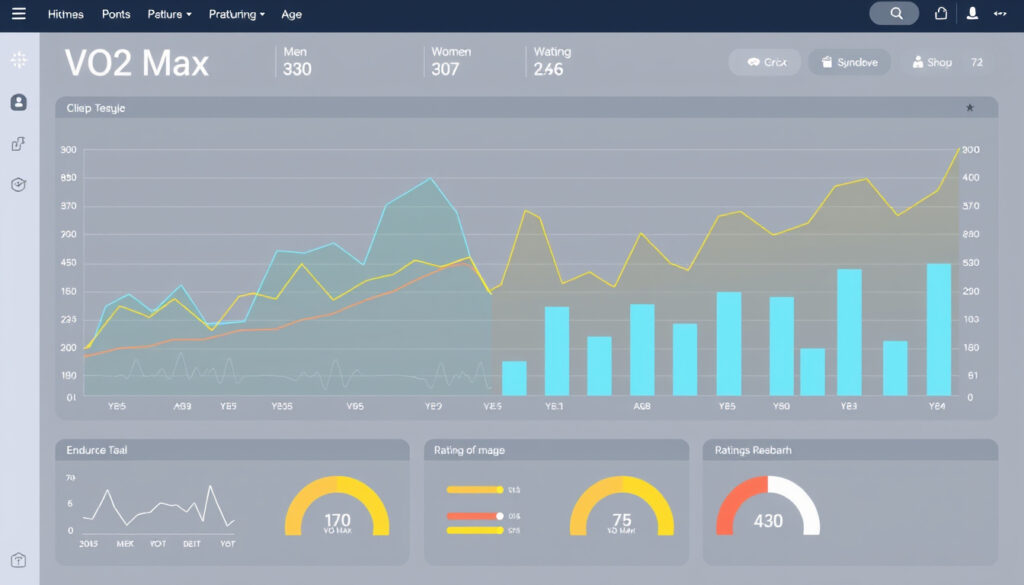
Fitness levels vary widely, but tools like this age- and gender-specific VO2 max chart help contextualize your score against established norms for men and women across ages.
Frequently asked questions
What is VO2 max?
VO2 max measures the maximum amount of oxygen your body can utilize during intense exercise, expressed in milliliters per kilogram of body weight per minute (ml/kg/min). It’s the gold standard for assessing cardiovascular fitness and aerobic endurance.
How does VO2 max change with age?
VO2 max typically peaks in your late 20s and then declines approximately 10 percent per decade after age 30. Consistent aerobic training can roughly halve this rate of decline, but some loss is inevitable even in highly trained athletes.
What is a good VO2 max by age and gender?
For adult men, VO2 max values above 35 ml/kg/min generally indicate good fitness across most age groups. For women, values above 25-28 ml/kg/min typically represent good fitness. The Cooper Institute and FRIEND Registry provide detailed percentile charts that break these down by specific age decades.
VO2 max chart by age?
Charts typically show 50th percentile values declining from around 48 ml/kg/min for men in their 20s to approximately 24 ml/kg/min by their 70s. Women follow a similar pattern starting from a baseline 15-30 percent lower. Garmin’s manuals and the Cooper Institute provide the most widely referenced standards.
How to calculate VO2 max by age?
Wearables like Apple Watch and Garmin devices estimate VO2 max during exercise using heart rate responses and movement patterns. Academic calculators (like those from NTNU or University of Kansas Medical Center) use regression equations based on age, sex, weight, height, and sometimes submaximal exercise test results.
Does VO2 max decline with age?
Yes, VO2 max declines roughly 10 percent per decade after age 30 in most people. This reflects natural changes in heart function, muscle oxygen extraction, and body composition. However, regular aerobic training significantly slows this decline.
What is elite VO2 max for men by age?
Elite VO2 max values for men typically exceed 60 ml/kg/min, with top endurance athletes (cross-country skiers, distance runners) reaching 70-94 ml/kg/min. These elite levels are rare and require years of dedicated training. For recreational athletes, VO2 max values between 40-55 ml/kg/min represent excellent fitness at most ages.
The pattern across all age groups is clear: your VO2 max at any given moment reflects a combination of genetic potential, training history, and current activity level. Chart norms give you a reference point, but the direction you move from here matters more than where you currently sit. For anyone past 40, the most actionable insight is that a 10 percent decline in VO2 max over a decade is not destiny—it’s a rate that structured aerobic training can substantially slow.
More related posts
 Villarreal vs Real Madrid: H2H, Latest Result & Predictions
 Pension Fund Inheritance Tax Changes 2027: UK Rules Explained
 Celta Vigo vs Barcelona – Preview, Prediction, Lineups
 Houses for Sale Wigan: Rightmove, Zoopla & Listings
 Celebrity Traitors UK 2025: Cast, Start Date, Episodes
 Things to Do in Brighton: Top Attractions & Activities
 Key Holder for Wall: Best Options, DIY Guide, and Placement Tips
 When to Plant Potatoes: Best Months and Ireland Tips
