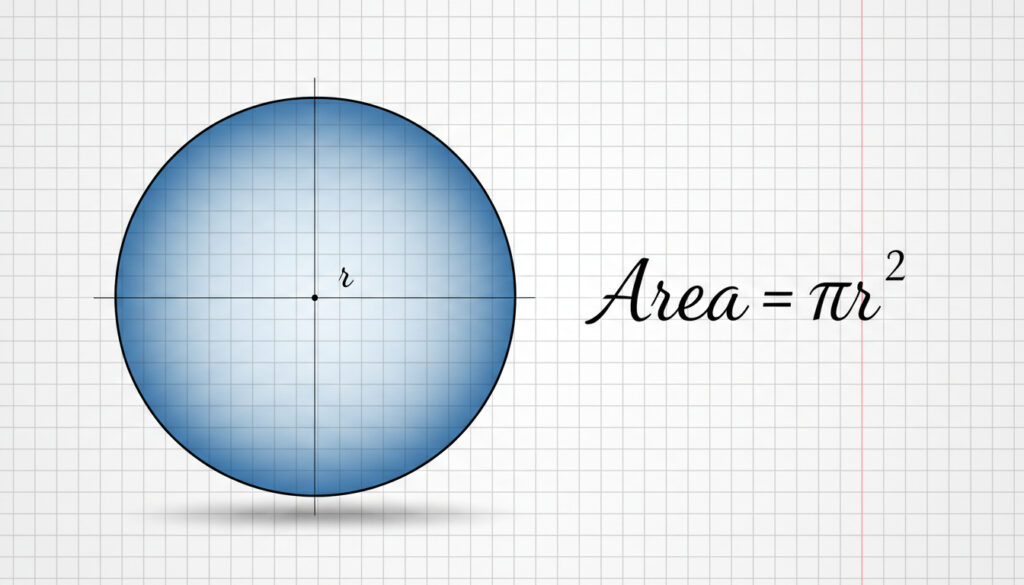
Area of a Circle – Formula and Step-by-Step Examples
The area of a circle represents the precise two-dimensional space enclosed within its curved boundary, calculated through the fundamental formula A = πr². This expression multiplies the mathematical constant π (approximately 3.14159) by the square of the radius, establishing the standard metric for circular measurement across science and engineering.
Ancient Greek mathematician Archimedes first rigorously proved this relationship around 250 BCE using geometric exhaustion methods. His foundational work underpins modern applications ranging from architectural planning to the calculation of pizza surface area.
What Is the Formula for the Area of a Circle?
The primary formula expresses area as the product of pi and the radius squared. Alternative formulations allow calculation from diameter or circumference when the radius remains unknown.
A = πr²
r = radius
π ≈ 3.14159
Square units (m², cm²)
Essential Properties
- Archimedes approximated π between 3 10/71 and 3 1/7 for early calculations.
- The formula derives from viewing the circle as the limit of regular polygons with increasing sides.
- Diameter conversion follows A = π(d/2)² or simplified as πd²/4.
- Circumference conversion uses A = C²/4π when only boundary length is known.
- π is an irrational number (3.1415926535…), requiring approximation for practical calculation.
- Area units must always be squared (e.g., centimeters become square centimeters).
- The result scales quadratically: doubling the radius quadruples the area.
Quick Reference Table
| Given Input | Formula Used | Calculated Area |
|---|---|---|
| Radius 5 cm | π × 5² | 78.54 cm² |
| Radius 7 cm | π × 49 | 219.91 cm² |
| Diameter 10 cm | π(10/2)² | 78.54 cm² |
| Diameter 20 cm | π(20/2)² | 314.16 cm² |
| Circumference 31.4 cm | 31.4²/(4π) | 78.50 cm² |
| Pizza (r = 15 cm) | 3.14 × 225 | 706.50 cm² |
How Do You Calculate the Area of a Circle?
Calculation methods vary based on available measurements. While radius provides the direct path, diameter and circumference serve equally valid starting points when adjusted correctly.
Using the Radius
Measure the distance from the center to any point on the boundary. Square this measurement, then multiply by π. Third Space Learning confirms this remains the standard computational approach for basic geometry.
Always square the radius before multiplying by π. Squaring after multiplication yields incorrect results. For radius 5 cm, compute 25 × π, not 5 × π then square.
Using the Diameter
Divide the diameter by 2 to obtain the radius, or apply the direct formula A = πd²/4. Math is Fun documents that a diameter of 10 cm yields the same 25π result as a 5 cm radius.
Using the Circumference
When only the boundary length C is known, rearrange the circumference formula to solve for radius, then substitute into the area formula. Omni Calculator provides interactive tools for this conversion.
For healthcare professionals tracking patient metrics, the NHS Blood Pressure Chart by Age and Gender – 2024 UK Guidelines offers relevant clinical reference data.
Why Is the Area of a Circle πr²? (Derivation)
The formula emerges from geometric limits rather than arbitrary definition. Wikipedia’s mathematical documentation traces the proof to ancient methods of polygon exhaustion.
The Method of Exhaustion
Archimedes inscribed and circumscribed regular polygons around a circle, increasing the number of sides indefinitely. As sides approach infinity, the polygon’s area converges to ½ × perimeter × apothem. This limit becomes ½ × C × r = ½ × 2πr × r = πr².
Visual Rearrangement
A circle divided into infinite sectors and rearranged forms a triangle with base C (circumference) and height r (radius). Triangle area formulas yield ½ × 2πr × r = πr². Calculator Soup details this geometric transformation.
Area of a Circle Examples and Applications
Practical implementation spans engineering specifications, consumer products, and physical sciences. Accurate calculation prevents material waste and ensures structural integrity.
Practical Calculations
A standard pizza with 15 cm radius covers approximately 706.5 cm². Engineering applications include calculating pipe cross-sections for fluid dynamics or determining wheel contact patches.
Area results must use squared units matching the radius measurement. A radius measured in centimeters requires area in square centimeters, not linear centimeters or cubic units.
Common Calculation Errors
Cuemath identifies frequent mistakes including confusing area with circumference, forgetting to square the radius, and using diameter directly without the dividing-by-4 adjustment.
Circumference (C = 2πr) measures boundary length in linear units. Area (A = πr²) measures enclosed surface in square units. These represent fundamentally different geometric properties.
How Did the Formula Develop Historically?
The mathematical certainty of the circle area formula emerged through gradual geometric refinement in ancient Greece.
- : Euclid’s Elements establishes foundational geometric theorems regarding circles.
- : Archimedes publishes Measurement of a Circle, rigorously proving the area formula and bounding π between 3 10/71 and 3 1/7.
- : Archimedes’ death; his methods remain the authoritative standard for circular geometry for millennia.
- : Calculus provides modern rigorous proofs of the limit processes Archimedes applied geometrically.
What Is Established Versus Approximated?
Mathematical certainty coexists with practical measurement limitations in circle calculations.
| Established Facts | Practical Uncertainties |
|---|---|
| Formula A = πr² is mathematically exact | Physical radius measurement contains instrument error |
| π is irrational (infinite non-repeating) | Computational truncation (3.14 vs 3.14159) affects precision |
| Archimedes proved the geometric relationship | Real-world circles are never perfect mathematical ideals |
| Units must be squared (dimensional analysis) | Conversion between unit systems introduces rounding |
Understanding Circle Area in Geometry
The area formula operates within a broader geometric framework relating circular measurements. While circumference quantifies the boundary, area quantifies the enclosed plane.
Real-world applications demand precise distinction between these metrics. Pharmaceutical calculations, such as those found in the Codeine Phosphate 30mg دواء – Uses, Dosage & Side Effects documentation, rely on exact measurement principles analogous to geometric precision, though applied to dosage rather than spatial area.
Sources and Mathematical Authority
Historical and modern sources confirm the geometric principles governing circular area.
Archimedes proved that the area of a circle is equal to that of a right-angled triangle having one side equal to the radius and the other to the circumference, establishing the foundational relationship A = ½Cr = πr².
— Historical summary based on Measurement of a Circle, c. 250 BCE
Summary of Circle Area Principles
The area of a circle follows the exact formula A = πr², derivable through geometric limits and applicable across scientific disciplines. While the mathematical relationship remains certain, practical application requires careful attention to unit consistency, measurement precision, and distinction from circumference calculations.
Frequently Asked Questions
What are the units for circle area?
Area always uses squared units (cm², m², in²) corresponding to the radius unit squared. A radius in meters yields area in square meters.
What is the difference between area and circumference?
Area (πr²) measures the enclosed surface in square units. Circumference (2πr) measures the boundary length in linear units. They describe different geometric properties.
How do you find the area if you only know the diameter?
Use the formula A = π(d/2)² or equivalently A = πd²/4. Divide the diameter by 2 to get radius, then apply the standard formula.
Why is the area formula πr² and not 2πr?
2πr calculates circumference (boundary length). Area requires squaring the radius because two-dimensional space scales with the square of linear dimensions.
What level of precision should I use for π?
Use 3.14 for basic calculations, 3.14159 for standard precision, or calculator π functions for exact symbolic computation. The irrational nature of π means exact decimal representation is impossible.
Can the area formula be used for partial circles?
Calculate the full area using πr², then multiply by the fraction of the circle present (e.g., ½ for semicircles, ¼ for quadrants).
More related posts
 32 Inches in CM – Precise Conversion and Practical Uses
 Highest Mountain in the World: Everest, Mauna Kea & More
 When to Plant Potatoes: Best Months and Ireland Tips
 How Do You Spell: Tips for English Words and Names
 Ayr United F.C.: Ownership, Rivalry, Stadium, and More
 Rachel Hurd-Wood: Life After Peter Pan
 C.S. Lewis: Biography, Last Words, Quotes, and Legacy
 Cast of The Full Monty: 1997 Original and 2023 TV Series
