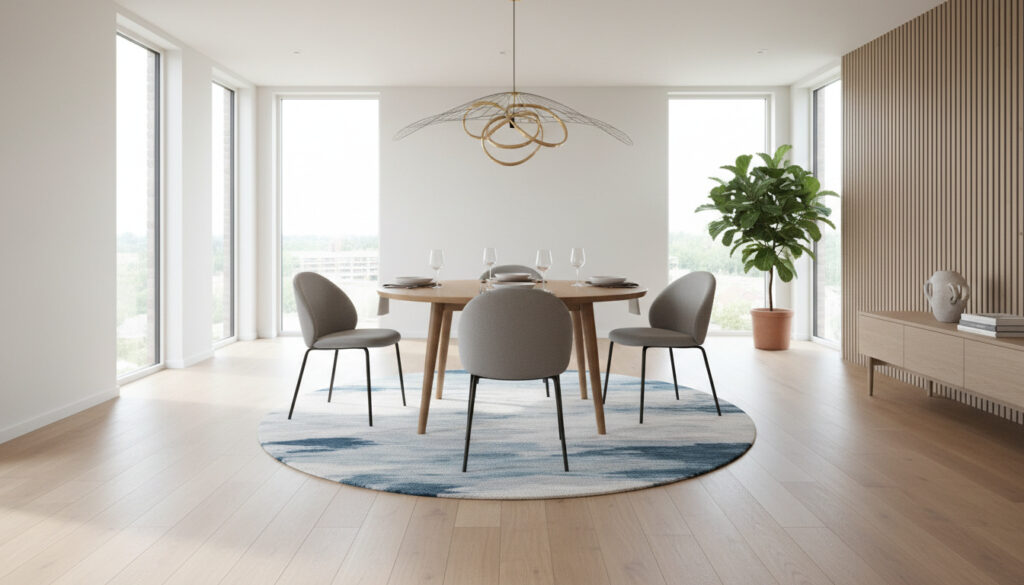
Round Dining Table for 4 – Ideal Sizes and Space Guide
Selecting the optimal round dining table for four people requires precise spatial calculations rather than aesthetic preference alone. Diameters ranging from 36 to 48 inches accommodate four diners, though comfort levels vary significantly across this spectrum. Understanding the relationship between tabletop circumference, chair dimensions, and circulation corridors prevents costly placement errors in compact dining areas.
Circular configurations eliminate corner interference, offering distinct advantages over rectangular alternatives in tight quarters. The geometry allows chairs to tuck closer to the center when not in use, effectively reducing the overall footprint by approximately 20% compared to four-seat rectangular equivalents. However, achieving this efficiency demands adherence to specific clearance standards and dimensional ratios.
Contemporary manufacturing offers pedestal and four-legged bases, each presenting unique spatial implications for legroom and seating flexibility. Material selection further complicates the decision matrix, with wood, glass, and metal surfaces presenting different maintenance requirements and visual weights. Buyers must balance these variables against budget constraints, particularly when seeking options under $500.
What Size Round Dining Table Seats 4 People Comfortably?
36–48 inches (90–120 cm)
24–30 inches per person
10×10 feet minimum clearance
Wood, Glass, Metal composites
Critical Sizing Insights
- Thirty-six inches represents the absolute minimum diameter, accommodating only armless chairs with minimal place settings.
- Forty-two to forty-four inches provides adequate space for armrest chairs and standard dinnerware simultaneously.
- Forty-eight inches offers generous elbow room for four diners or accommodates five in occasional scenarios.
- Standard table height remains consistent at 30 inches (76 cm) across virtually all residential models.
- Each diner requires approximately 24 inches of width and 15 inches of depth for comfortable place settings.
- Round geometries reduce required floor space by eliminating corner clearance needs.
- Pedestal bases maximize usable legroom compared to leg-supported alternatives.
| Feature | Standard Specification | Practical Notes |
|---|---|---|
| Minimum Diameter | 36 inches (90 cm) | Tight fit; armless chairs only |
| Recommended Diameter | 42–44 inches (105–110 cm) | Accommodates armrests comfortably |
| Spacious Diameter | 48 inches (120 cm) | Seats 4–5 with ample legroom |
| Table Height | 30 inches (76 cm) | Universal standard for dining |
| Chair Pull-out Clearance | 28–32 inches (70–80 cm) | Distance from table edge |
| Walking Clearance | 36–48 inches (90–120 cm) | Minimum around table perimeter |
| Weight Capacity | 200–400 lbs | Varies by base construction |
| Setting Width per Person | 24 inches | Elbow room requirement |
| Setting Depth per Person | 15 inches | Plate and utensil space |
| Total Footprint (48″ table) | 10–11 feet diameter | Including chairs and clearance |
Best Round Dining Tables for 4 People in 2025
Current market analysis reveals limited aggregated review data specifically dated 2025 for round dining tables in the four-seat category. Retailer inventories consistently feature 120 cm (48-inch) pedestal models as versatile anchor pieces, capable of seating four comfortably while accommodating occasional fifth guests. Compact 42-inch configurations maintain popularity for urban apartments where spatial constraints outweigh expansion needs.
Budget constraints under $500 necessitate prioritization of fundamental structural integrity over premium finishes. Big-box retailers typically stock 36–42 inch wood or metal pedestal options within this price bracket, though specific model availability fluctuates seasonally. ANSI/BIFMA certification serves as a critical quality indicator for budget selections, ensuring commercial-grade stability standards despite residential pricing.
Options Under $300
The sub-$300 segment primarily delivers 36-inch basics suitable for breakfast nooks or temporary arrangements. These compact units typically feature simplified pedestal designs or four-leg constructions with minimal overhang. Durability concerns emerge in this bracket regarding joint integrity and surface resistance to daily wear.
Verify ANSI/BIFMA certification labels when purchasing tables under $500. These standards ensure structural integrity, stability testing, and safety requirements including 300-pound minimum load capacity per seating position.
Round vs Other Table Shapes for 4 Diners
Circular tables facilitate egalitarian dining dynamics, eliminating hierarchical seating arrangements inherent to rectangular head-of-table positions. The continuous edge supports conversational flow, allowing diners to maintain eye contact without neck strain. Spatially, the Area of a Circle geometry eliminates wasted corner space, permitting placement in smaller rooms than rectangular alternatives of equivalent seating capacity.
Pedestal vs Four-Legged Construction
Pedestal bases dominate small-space applications for round tables measuring 100–120 cm in diameter. Central support columns eliminate leg interference at seating positions, maximizing available legroom for all four diners. Base diameter typically mirrors tabletop dimensions to prevent tipping while maintaining visual proportion.
Four-legged alternatives present potential obstruction at chair placement points, particularly when legs align with seating positions. Armchair compatibility suffers notably in leg-supported designs, as chair arms may collide with table legs when diners attempt to slide forward. This limitation becomes critical in 36–40 inch tables where every inch of ingress space matters.
Performance in Compact Spaces
Round configurations excel in square rooms or corner placements where rectangular tables create awkward circulation paths. The absence of corners allows chairs to tuck tightly when unoccupied, reducing the operational footprint by approximately six to eight inches per side compared to rectangular four-seaters. Dimensional studies confirm that round tables optimize angular room layouts more efficiently than rectilinear alternatives.
Maintain minimum 36 inches (90 cm) clearance between table edge and walls or furniture. Insufficient clearance prevents proper chair extraction and creates hazardous traffic patterns during meal service.
Key Factors When Choosing a Round Dining Table for 4
Material selection dictates longevity and maintenance requirements. Wood surfaces offer repairability but require periodic conditioning. Glass tops visually expand spatial perception but demand constant cleaning and present weight limitations. Metal frames provide structural rigidity though may introduce industrial aesthetics incompatible with traditional interiors.
Material Considerations
Hardwoods dominate mid-range markets, offering refinishing potential absent in veneer or composite alternatives. Tempered glass surfaces accommodate modern aesthetics while resisting thermal shock, though weight restrictions limit base options. Powder-coated metal bases pair with various top materials, providing consistent structural support across price segments.
Measurement Protocols
Physical tape measurement supersedes visual estimation when planning table placement. Create a floor template using painter’s tape to outline the table perimeter plus 36-inch clearance boundaries. Test chair movement within this boundary before purchasing, noting that armchairs require additional extraction space compared to armless alternatives.
Central pedestal bases accommodate varying chair sizes more flexibly than four-legged designs. The absence of corner legs allows irregular chair placement and supports easier cleaning access beneath the table center.
How Round Table Design Evolved for Modern Dining
- Ancient Roman Period: Circular dining surfaces symbolized equality among diners, eliminating hierarchical seating arrangements found at rectangular triclinium tables. This egalitarian tradition established the psychological precedent for round tables facilitating democratic conversation.
- Post-WWII Era: Pedestal base popularity surged during mid-century modern movements, emphasizing open floor plans and streamlined silhouettes. Manufacturing advances enabled stable central support columns capable of bearing substantial cantilevered tops.
- 2020s Sustainability Trend: Contemporary production emphasizes FSC-certified hardwoods and recyclable metal alloys. Extendable round mechanisms gained prominence, allowing 48-inch tables to accommodate six diners when expanded, addressing urban space constraints through multifunctionality.
Established Facts vs Variable Considerations
Confirmed Standards
- Forty-two inch diameter seats four comfortably per furniture industry standards
- Thirty-inch height remains universal across residential dining categories
- Pedestal bases maximize legroom in sub-48-inch diameters
- Minimum 36-inch clearance required for safe chair extraction
Variable Factors
- Exact clearance requirements vary by armchair dimensions (add 6–12 inches)
- Specific 2025 model availability under $500 remains undocumented in current data
- Weight capacity ratings differ significantly between manufacturers
- Material durability varies by household usage patterns and maintenance
Why Choose a Round Dining Table for 4?
Circular geometries optimize social interaction by equalizing sightlines and conversational distance among four participants. Unlike rectangular configurations where end-seat diners face isolation, round tables maintain equitable engagement across all positions. This psychological benefit complements the physical space savings achieved through corner elimination.
Spatial efficiency extends beyond the tabletop to circulation patterns. Round tables permit diagonal movement through dining areas, whereas rectangular blocks create linear traffic jams. The Garden Parasol with Base principle of central weight distribution similarly applies to round dining bases, providing stability without sprawling leg structures.
Visual continuity represents another advantage, particularly in open-plan living spaces. The absence of sharp corners softens room geometry, preventing the “boxing” effect that rectangular furniture creates in compact apartments. Round silhouettes guide eye movement around rather than against spatial boundaries.
Expert Insights & Data
ANSI/BIFMA X5.5 standards establish structural integrity benchmarks including cycle testing for table tops and legs, stability requirements, and safety protocols mandating 300-pound minimum load capacity per seat. While these standards originally targeted commercial environments, residential applications benefit from equivalent durability certifications.
Furniture Industry Testing Standards
Comprehensive sizing research confirms that 48-inch round tables require approximately 10–11 feet of total floor space when accounting for chair extraction and pedestrian circulation. This metric guides architects and interior designers when specifying furniture for compact dining rooms or kitchen alcoves.
Next Steps for Buyers
Begin with precise spatial measurement using tape outlines to verify clearance requirements. Establish budget parameters recognizing that ANSI/BIFMA-certified options under $500 exist primarily in 36–42 inch categories. Prioritize pedestal bases for maximum seating flexibility, particularly when selecting armchairs. Confirm material maintenance requirements align with household usage patterns before finalizing selection.
Frequently Asked Questions
Can a 36-inch round table actually seat 4 people?
Yes, but with significant constraints. Thirty-six inches accommodates four armless chairs with minimal place settings. Elbow room becomes restricted, and serving dishes may not fit centrally. This size suits temporary or breakfast-only use rather than formal dining.
How much wall clearance does a 42-inch round table require?
Minimum 36 inches from table edge to wall. Forty-two to forty-eight inches provides comfortable traffic flow. Spatial planning guidelines recommend additional clearance if doors open into the dining area.
Are round tables better than rectangular for small apartments?
Generally yes. Round tables eliminate corner interference, allowing chairs to tuck tighter when unoccupied. The geometry permits diagonal traffic patterns impossible with rectangular blocks, effectively reclaiming 15–20% of functional floor space.
What is the best material for a round dining table with children?
Hardwoods with protective finishes offer optimal durability and repairability. Glass presents fingerprint and smudge maintenance challenges. Metal frames withstand impact but may show dents. Avoid untreated porous stones that stain easily.
Do pedestal tables tip easily compared to four-legged designs?
Properly engineered pedestal bases with adequate footprint diameter (typically matching tabletop size) provide equivalent stability to four-legged alternatives. ANSI/BIFMA-certified pedestals undergo rigorous tipping tests exceeding residential requirements.
Can I fit armchairs around a 40-inch round table?
Marginal comfort exists at forty inches. Armchairs require careful selection with narrow arm profiles. Forty-two to forty-four inches provides standard armchair accommodation without contact between chair arms and table edges during ingress or egress.
Is 30 inches the standard height for all round dining tables?
Thirty inches (76 cm) represents the overwhelming standard for residential dining height. Counter-height variants measure 36 inches, while bar-height options reach 42 inches. Standard chair seat height of 18 inches corresponds specifically to the 30-inch table specification.
More related posts
 Great Little Escapes Collapse: Your Rights & Refunds
 Livery Yards Near Me: Prices, Types & How to Choose in Ireland
 CBT Test Near Me: Cost, Duration & How to Pass in a Day
 Oxva Xlim Pro 2 Review: Battery, Coils & Performance
 Cast of IT Chapter 1 – Full Actors List and Key Roles
 Morocco National Football Team: History, Players & World Cup 2026
 What Is 6 7? Viral TikTok Slang Meaning Explained
 Post Office Bank Account Guide: Open, Requirements & Benefits
